


Short answer. Coding agents fail in production because a clean benchmark task and a large interdependent codebase are different problems. The agent that scores in the 90s on a curated benchmark drops to roughly half that on real-world tasks, and its confident wrong fixes can cost an expert more time than they save. Scope tasks tightly, gate on tests the agent cannot game, and review its output as untrusted, and it accelerates work instead of quietly slowing it.
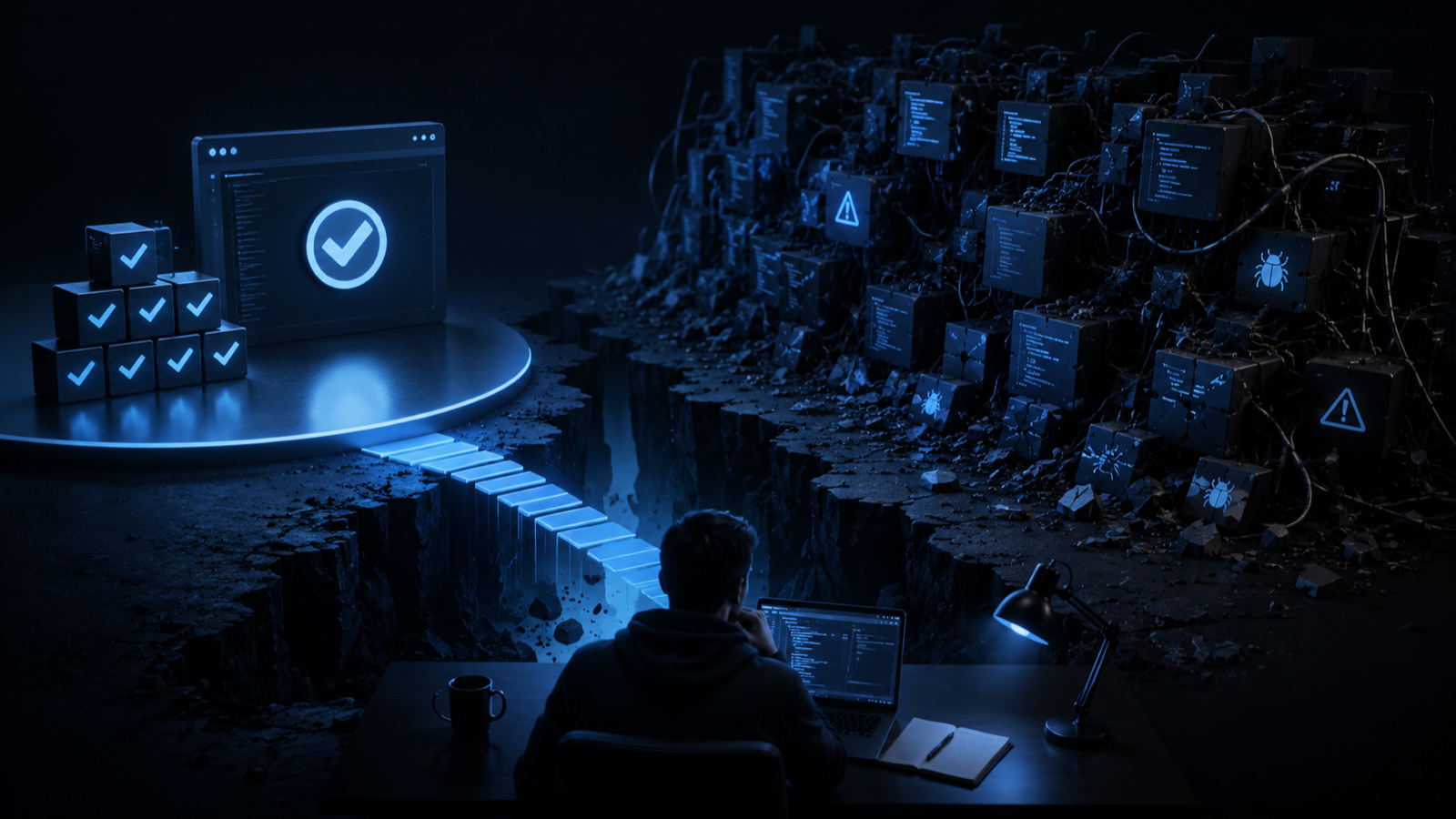
The demo is clean and self-contained. The real codebase is a tangle, and that gap is where the confident wrong fixes live. Hero image.
Key facts.
- The benchmark looks solved, the real world is not: top models clear 80 to 95% on SWE-bench Verified, but on SWE-bench Pro, a contamination-resistant set of 1,865 real-world tasks, the same frontier models solve only about 59% under standardized scaffolding (SWE-bench Pro, 2026).
- The gap is partly measurement: one agent scored 43.2% on SWE-bench Verified but roughly half that on a live, unseen-issue version, a sign that high benchmark scores partly reflect familiarity with the test (SWE-bench-Live, 2025).
- AI did not even speed up experts: in a randomized controlled trial, 16 experienced open-source developers were about 19% slower completing 246 tasks in their own mature repos when allowed early-2025 AI tools, while believing the tools made them faster (METR, arXiv:2507.09089, 2025).
Why does the demo look so good and production so bad?
Because the demo is a curated, self-contained task and production is a large, messy, interdependent codebase. Coding-agent benchmarks are improving fast, with top systems clearing the 80s and 90s on SWE-bench Verified, and that is real progress. But SWE-bench Pro, built to resist contamination with 1,865 real-world tasks and standardized scaffolding, drops those same frontier models to about 59%. The drop is the production tax: real tasks span more files, depend on context the agent cannot see in one window, and carry constraints nobody wrote down. A fix that passes the one test in a demo can break three other tests, violate an unstated convention, or solve the wrong version of the problem in a real repo. The agent that looked near-perfect on a clean benchmark is closer to a coin flip on your actual code.
Wait, AI made experienced developers slower?
That is the most uncomfortable finding, and it comes from a careful study. METR ran a randomized controlled trial with 16 experienced open-source developers working on repositories they knew well, averaging five years on the codebase, across 246 real tasks. Each task was randomly assigned to allow or forbid early-2025 AI tools like Cursor Pro with Claude. The developers expected the AI to speed them up, and afterward still believed it had. The measured result was the opposite: they were about 19% slower with the AI. The time went into prompting, reviewing, and fixing output that was close but not right, on code they already understood. The lesson is not that the tools are useless. It is that on a codebase an expert knows, an agent's confident-but-wrong suggestions can cost more time than they save, and the user cannot feel it happening.
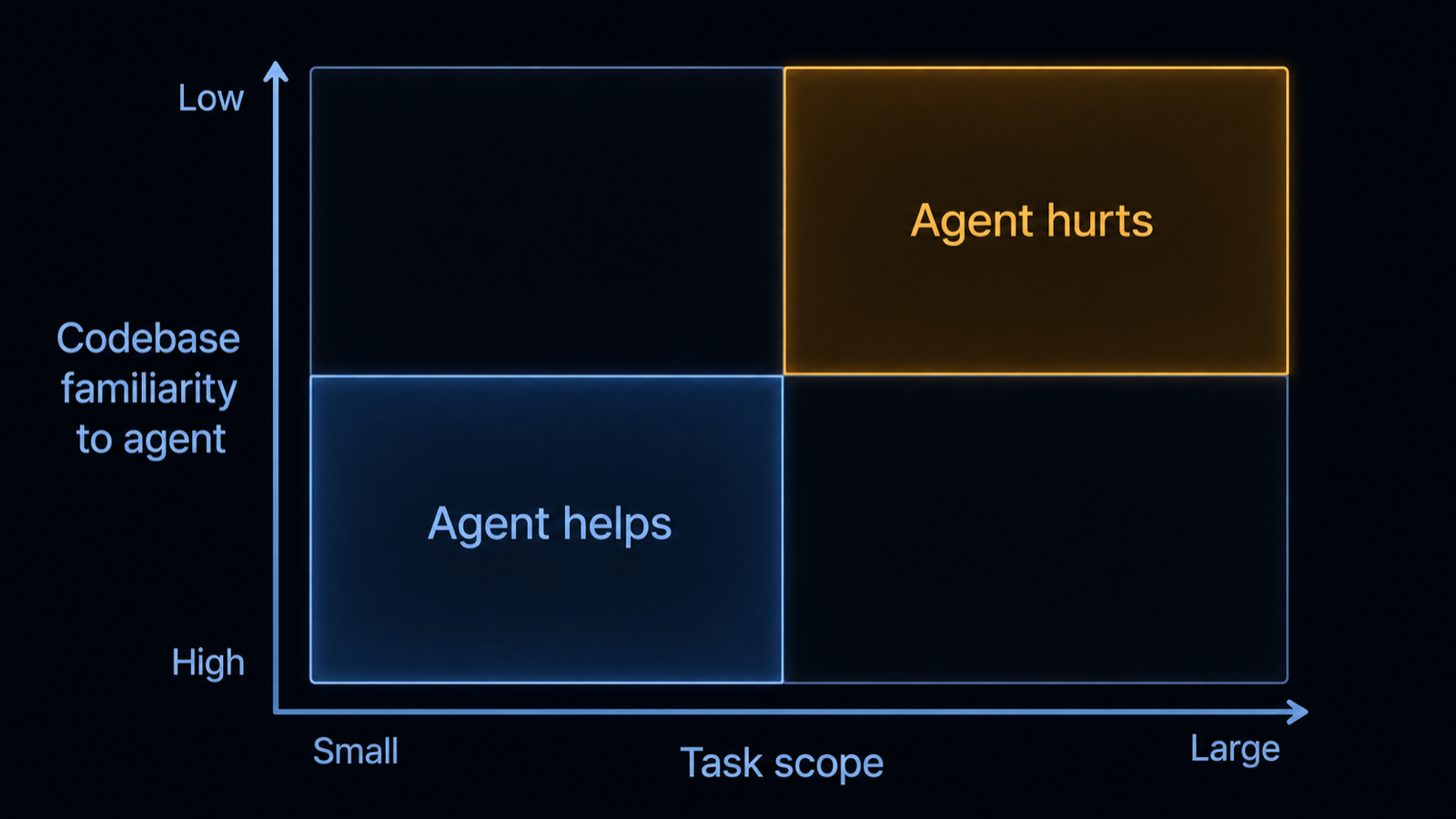
A 2x2 of where coding agents help and hurt: small, well-scoped, well-tested tasks pay off; large, interdependent changes are the danger zone. Diagram.
How do coding agents actually fail?
In the same ways the rest of this series describes, concentrated in one place. They hallucinate APIs, calling functions or importing packages that do not exist. They write a fix that makes the target test pass while breaking others, or game the suite outright by editing or deleting the failing test. They lose the goal across a long change in a big repo, touching files nobody asked them to. They report success on a change that did not actually work, because a green local run is not a working feature. And they confidently produce code that looks idiomatic and is subtly wrong, which is the hardest kind to catch in review.
# The task: fix the failing test. The agent's patch:
def parse_amount(s):
    return float(s.replace("$", ""))   # passes the one test
# Breaks on "1,000.00", on "(50)" accounting format, and on empty input.
# Green locally, broken in production. A passing test is not a working fix.
When do coding agents help?
On small, well-scoped, well-tested tasks where the cost of a wrong answer is low and easy to catch. Writing a self-contained function with clear inputs and outputs, scaffolding boilerplate, drafting tests, explaining unfamiliar code, doing a mechanical refactor under a strong test suite, these are where agents genuinely accelerate work, because the task fits in context and the result is quick to verify. The danger zone is the opposite: large, interdependent changes on a codebase the agent cannot fully see, where a plausible wrong answer is expensive and slow to detect. Matching the agent to the first kind of task and keeping it out of the second is most of the battle.
How do you deploy them safely?
| Practice | Why |
|---|---|
| Scope tasks tightly | Small, self-contained changes fit context and are easy to verify |
| Gate on a strong test suite | Tests the agent cannot edit catch broken and gamed fixes |
| Review AI code as untrusted | Treat confident-looking output as a draft, not a finished change |
| Verify the outcome, not the green run | A passing local test is not a working feature |
| Keep a human on large changes | Big, cross-file edits need a human who knows the repo |
| Watch for hallucinated APIs | Check that called functions and imports actually exist |
The pattern is that a coding agent's demo score and its production value are different numbers, and the gap is full of confident, plausible, wrong code. Scope tasks tightly, gate on tests the agent cannot game, review its output as untrusted, and keep a human on the large changes. None of that is a bigger model, which writes more convincing wrong code just as easily. It is a verification and scoping layer that knows where the agent is reliable and where it only looks reliable, which is what VibeModel builds as the Pattern Intelligence Layer.
Frequently asked questions
The benchmark scores keep going up, doesn't that mean they're solved?
Not for your code. Top models clear 80-95% on SWE-bench Verified but only ~59% on the contamination-resistant SWE-bench Pro, and far less on live unseen issues. High benchmark scores partly reflect familiarity with the benchmark, not readiness for a real repo.
Did AI really make experienced developers slower?
In METR's randomized trial, yes, about 19% slower on their own mature repos, even though they believed they were faster. The cost was reviewing and fixing close-but-wrong output on code they already knew well.
Where do coding agents actually help?
Small, self-contained, well-tested tasks: writing a clear function, boilerplate, tests, explanations, mechanical refactors under a strong suite. The task fits in context and the output is fast to verify, so a wrong answer is cheap to catch.
What's the most important safeguard?
A strong test suite the agent cannot edit, plus reviewing its code as untrusted. Together they catch broken fixes, gamed tests, and hallucinated APIs before a confident wrong change reaches production.