


Short answer. Do not use an agent when you can map the steps in advance. A workflow you define, with model calls at controlled points, gives you more accuracy, more control, lower cost, and an audit trail than handing the model the wheel. Reserve agents for genuinely ambiguous, open-ended, high-value tasks where you cannot pre-draw the decision tree. Match the tool to the task and most agent failures never start.
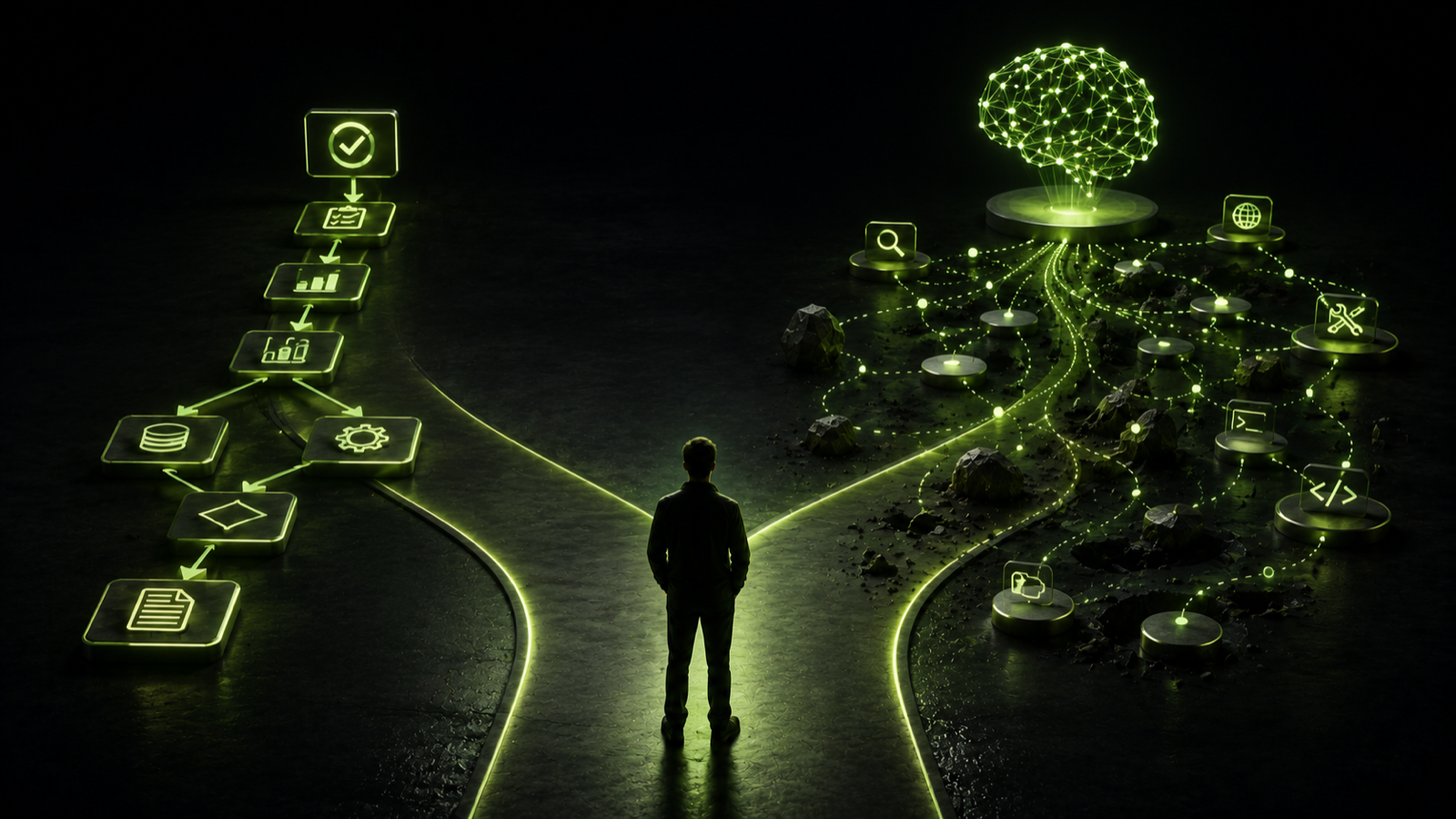
Most tasks belong in the simple, predictable pipeline on the left. The elaborate autonomous rig is for the few that genuinely need it. Hero image.
Key facts.
- The market is about to correct: Gartner predicts over 40% of agentic AI projects will be canceled by the end of 2027, citing escalating costs, unclear business value, and inadequate risk controls (Gartner, June 2025).
- A lot of it is not even agents: Gartner calls out "agent washing", rebranding chatbots, RPA, and assistants as agentic, and estimates only about 130 of the thousands of agentic-AI vendors are real (Gartner, 2025).
- The builders agree, build less: Anthropic's "Building Effective Agents" advises finding the simplest solution that works, which "might mean not building agentic systems at all", and reserving agents for tasks that genuinely need model-driven decisions (Anthropic, 2024).
Why are 40% of agent projects about to be cancelled?
Because most of them are solving a problem an agent is the wrong tool for. Gartner's prediction that over 40% of agentic AI projects will be canceled by the end of 2027 names the reasons directly: escalating costs, unclear business value, and inadequate risk controls. Much of the current wave is proof-of-concept work driven by hype rather than a real need for autonomy. Gartner also points at "agent washing", vendors rebranding chatbots, RPA flows, and assistants as agents without real agentic capability, and estimates only about 130 of thousands of agentic vendors are the genuine article. The cancellations are not a failure of the technology so much as a correction: tasks that never needed an autonomous agent were built as one, and the cost and unreliability caught up.
Workflow or agent? The real distinction
There is a clean line, and Anthropic draws it. A workflow is multiple model calls in a control flow you define: you decide the steps, and the model fills each one in. An agent is different, the model owns the plumbing, deciding for itself what to do next and which tools to call. Workflows give you predictability and consistency on well-defined tasks; agents give you flexibility when the task genuinely needs model-driven decisions. The mistake is reaching for the agent by default. As Anthropic puts it, do not build agents for everything, and find the simplest solution that works, which might mean not building an agentic system at all. The question is not how to build an agent. It is whether you need one.
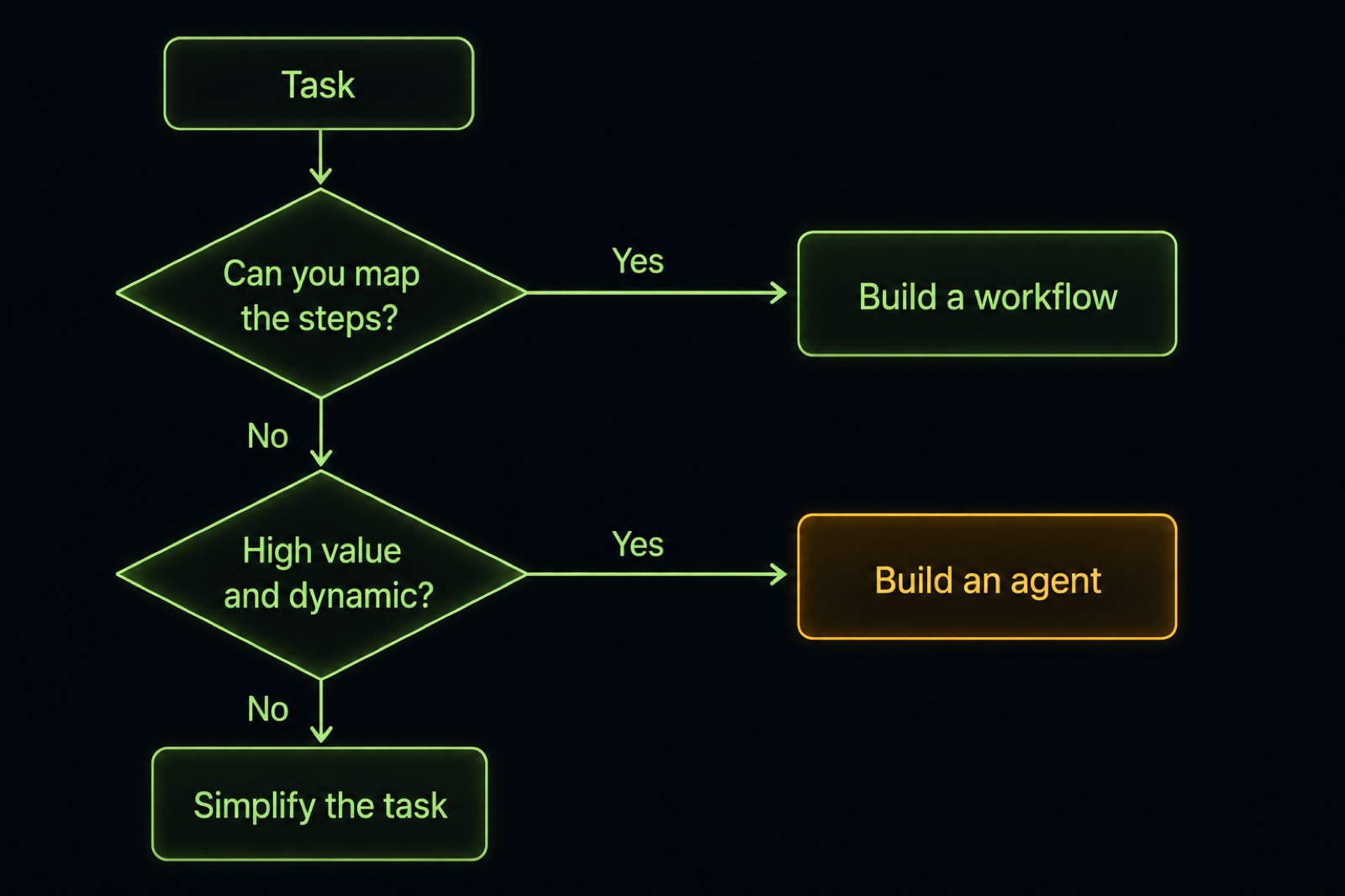
The decision: if you can map the steps, build a workflow; only a genuinely unmappable, high-value, dynamic task should reach the agent branch. Diagram.
When a workflow wins
Whenever you can map the decision tree. If you can write down the steps and the branches in advance, build that as a workflow and optimize each node, and you get more accuracy, more control, and lower cost than any agent will give you. This covers most business automation: a defined process with known inputs, a fixed set of steps, and a clear right answer. It is also where determinism and auditability matter, in compliance, finance, and anything regulated, where "the model decided" is not an acceptable explanation and you need the same input to produce the same, traceable output. An agent's autonomy is a liability there, not a feature. A workflow that calls a model at specific, controlled points gives you the model's capability without handing it the wheel.
When an agent actually fits
When the task is genuinely ambiguous enough that you cannot pre-map the path. If the right next step depends on what the previous step found, if the space of actions is open-ended, if a person would say "it depends" and start exploring, that is where an agent earns its cost and its unpredictability. Open-ended research, complex troubleshooting, broad exploration across many tools, these are the cases where dynamic, model-driven decision-making is the point, and a rigid workflow would be worse. The honest test is whether you can draw the flowchart. If you can, build the flowchart. If you genuinely cannot, and the task is valuable enough to pay for the tokens and accept the variance, an agent fits.
A decision framework
| If | Then |
|---|---|
| You can map the steps and branches | Build a workflow, not an agent |
| The task needs the same output every time | Workflow, for determinism and audit |
| It is regulated or high-stakes | Workflow with controlled model calls and human gates |
| The next step depends on the last, open-endedly | Consider an agent |
| The space of actions is large and dynamic | Agent, if the value clears the cost |
| You are reaching for an agent because of the hype | Stop; use the simplest thing that works |
The pattern is that an agent is the most expensive, least predictable way to automate a task, and it is the right choice only when the task genuinely needs autonomy you cannot script. Map what you can into a workflow, reserve agents for the truly ambiguous and high-value, and put determinism and audit where the stakes demand them. None of that is a bigger model, which makes a misapplied agent more expensive, not more appropriate. It is the judgment of which tasks deserve an agent at all, which is what VibeModel builds as the Pattern Intelligence Layer.
Frequently asked questions
Aren't agents the future, though?
For some tasks, yes. But Gartner expects over 40% of agent projects to be canceled by 2027 because they were applied to tasks that did not need autonomy. The future is matching the tool to the task, not making everything an agent.
How do I tell if my task needs an agent?
Try to draw the flowchart. If you can map the steps and branches in advance, build a workflow, it is cheaper, more accurate, and auditable. Only a task you genuinely cannot pre-map, and that is valuable enough to justify the cost, needs an agent.
What's the most common over-automation mistake?
Using an autonomous agent for a well-defined, repeatable process, often regulated, where a deterministic workflow would be more reliable and explainable. The agent adds cost and variance and removes the audit trail.